Top 10 AI Robots for Business Buyers in 2026

Choosing an Ai Robot for a business is less like buying a gadget and more like adding a new worker to a real operation. A warehouse may need reliable pallet movement, while a hotel may value clear guest interaction and smooth handoffs to staff. In a factory, the key test could be whether a robot can inspect the same surface consistently under changing light. Small details matter: doorway width, floor transitions, Wi-Fi dead zones, cleaning routines, and who responds when a unit stops mid-shift.

This 2026 guide compares ten robots through practical business questions, not novelty alone. It considers task fit, autonomy, navigation, integration, maintenance, support, and the evidence buyers should request during a demonstration. A polished demo is useful, but it cannot show every crowded corridor or awkward exception. That gap matters. Buyers should ask for measurable trial goals, realistic operating conditions, and clear estimates of setup and ongoing costs. They should also check how each system handles data, human oversight, and updates, since these details vary by product and deployment. No ranking can replace a site assessment, and some promising systems may prove cumbersome in daily use. That is worth admitting. The strongest choice is usually the one that solves a defined, repeated problem and fits existing workflows, rather than the one with the most impressive feature list.
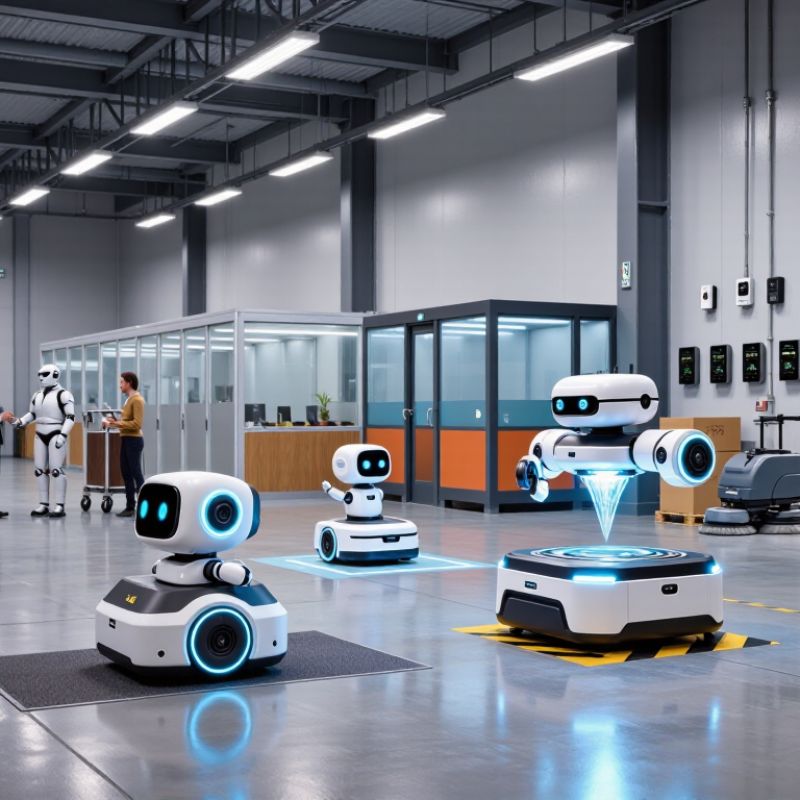
Top 10 AI Robots for Business Buyers in 2026

AI Robots for Business: Definition and Scope in 2026

Top 10 AI Robots for Business Buyers in 2026

AI Robots for Business: Definition and Scope in 2026

An AI robot combines a physical machine with sensors, software, and decision-making systems. It can perceive its surroundings and adjust actions, rather than repeat only fixed movements. Business examples include mobile units moving cartons, inspection systems checking product surfaces, and collaborative arms assisting with assembly. Purely digital chatbots are not robots; conventional machines following preset routines may not qualify as AI robots either. The boundary can be fuzzy. Buyers should examine what the machine actually does, not just its label.

The International Federation of Robotics reported 4.28 million industrial robots operating worldwide in 2023, with 541,302 new installations that year in World Robotics 2024. These figures cover industrial robots broadly, not AI robots alone. They show the scale of business automation, but do not prove that AI will suit every workplace.

In 2026, buyers should assess the full system: sensors, models, safety controls, connectivity, maintenance, and human oversight. A robot that works well in a clean demonstration area may struggle with glare, clutter, or changing shift patterns.

Tips: Define one measurable task before comparing machines. Test using real lighting, loads, and floor conditions. Ask how errors are logged and who can intervene. Small details matter. Pilot the system on a limited workflow, and record downtime alongside output. The evaluation may still miss something; revise it after staff use the machine.

How to Evaluate AI Robots for Business Use

Evaluate an AI robot against a specific job, not a polished demonstration. Map the route, shift length, payload, floor conditions, and handoff points. Then test the robot where it will actually work. A tidy demo can mislead.

The International Federation of Robotics reported nearly 205,000 professional service robots sold in 2023, up 30% from 2022. Transportation and logistics accounted for about 113,000 units. These figures cover professional service robots, not AI-only models, but they show why mobility and workflow fit deserve close scrutiny. During a pilot, track completed tasks, human interventions, downtime, and cost per successful job. Keep the baseline. Otherwise, “better” may only mean better-looking.

Check how the system handles blocked paths, uncertain instructions, and lost network access. Ask what data it collects, where that data is stored, and who can review incident logs. NIST’s AI Risk Management Framework recommends identifying and managing risks throughout an AI system’s lifecycle. That includes ongoing monitoring, not just pre-purchase testing. I would still leave room for doubt: a short pilot cannot reveal every maintenance issue or seasonal change. Train operators on manual recovery, and measure results across ordinary shifts, not only ideal ones.

Top 10 AI Robots for Business Buyers in 2026

For business buyers in 2026, the top ten AI robot categories are collaborative arms, autonomous mobile robots, inventory scanners, floor-cleaning robots, inspection robots, reception robots, telepresence units, goods-picking robots, agricultural robots, and healthcare delivery robots. This is a practical shortlist, not a universal ranking. Each category solves a different operational problem. A collaborative arm may handle repetitive assembly, while a mobile robot can move sealed totes between workstations. An inventory scanner can check high shelves after closing. Small gains matter.

Before buying, measure the task in minutes, errors, and staff workload. Ask for a live trial in the actual workspace, including busy periods and awkward corners. Check how the robot handles blocked routes, low lighting, and changes to shelves or floor layouts. Confirm training, maintenance, software support, and integration costs; the purchase price tells only part of the story. A reception robot may look impressive in a quiet lobby but struggle when visitors arrive together. That matters. I would also ask operators what they find frustrating, not just managers. No robot is fully autonomous in every setting, and even a strong pilot can expose gaps. The best fit is the one workers can use safely and consistently.

Top 10 AI Robot Categories for Business Buyers in 2026

Indicative business deployment readiness, rated on a qualitative 1–5 scale.

Established categories such as industrial arms, collaborative robots, and autonomous mobile robots are generally more deployment-ready. Ratings are a qualitative comparison of commercial maturity, not measured market shares or a standardized performance benchmark; suitability depends on the task, site, and integration requirements.

Comparing Robot Capabilities, Costs, and Integration Needs

Choosing an AI robot in 2026 starts with the task, not the feature list. A mobile unit may move bins across a warehouse, while a vision-equipped arm can inspect parts under steady lighting. Neither is automatically useful everywhere. Measure the job: distance travelled, objects handled, exceptions, and time saved per shift. Small details matter. A glossy demo rarely shows a blocked aisle or a scuffed label.

Costs extend beyond the purchase price. Include installation, software, staff training, routine maintenance, and downtime during updates. Ask for service response times and a clear estimate of consumables. Then compare the total cost over several years with the current process. The estimate will still be imperfect. That is normal. A short pilot, with agreed measures such as completed tasks per hour and manual interventions, can expose optimistic assumptions before a larger commitment.

Integration can be the harder part. Check whether the robot can exchange task data with existing inventory or production systems, and whether the facility’s Wi-Fi covers its full route. Confirm how workers pause, redirect, or safely recover the machine. Test these steps on a busy shift, not an empty floor. Keep the first deployment narrow. A robot that performs one measurable job reliably may be a better investment than a more capable system that needs constant supervision.

Matching AI Robots to Business Tasks and Environments

A useful shortlist of AI robots starts with the work, not the machine. Map each task to its setting: indoor delivery needs clear routes and safe stopping; inventory scanning needs reliable camera views between shelves. A robot suited to a smooth warehouse floor may struggle with crowded hallways or changing layouts. Small details matter.

Match capabilities to daily conditions. For repetitive transport, check payload, doorway clearance, charging time, and how the robot behaves when a cart blocks its path. For inspection, consider lighting, dust, and whether staff can review flagged images. In customer-facing spaces, quiet movement and clear handoff signals may matter more than speed. Not everywhere. A polished demo cannot prove performance during a busy shift.

Before buying, run a limited pilot in the actual work area. Record completed tasks, human interventions, downtime, and minutes saved, using the same measures each week. Ask operators where the robot creates extra steps; their feedback often reveals problems a specification sheet misses. Keep a fallback process for exceptions, and confirm that staff can safely pause or redirect the system. Results may disappoint at first. That is useful evidence: adjust the task, environment, or deployment plan before expanding.

Top 10 AI Robots for Business Buyers in 2026 - Matching AI Robots to Business Tasks and Environments
Robot Type Best-Fit Business Tasks Suitable Environment Typical Capabilities Buyer Checks
Autonomous mobile robot (AMR) Moving totes, components, or supplies between work areas; replenishing production or fulfillment zones. Warehouses, factories, hospitals, and other mapped indoor spaces with changing foot traffic. Uses onboard sensing and navigation to travel along routes while adapting to obstacles; may connect to fleet-management software. Check payload, route and elevator needs, traffic rules, charging plan, fleet integration, and safe operation around people.
Automated guided vehicle (AGV) Repeated transport along stable, predictable material-flow routes. Facilities with structured layouts and consistent paths, such as production lines and distribution centers. Follows defined guidance or navigation references and can automate routine point-to-point movement. Assess route changes, floor condition, crossing points, traffic management, load type, and the cost of infrastructure changes.
Collaborative robot arm (cobot) Repetitive assembly, screwdriving, pick-and-place, packaging, and inspection assistance. Workcells where people and robotic equipment share space, subject to a task-specific safety assessment. Programmable arm with configurable motion and end-effectors; some systems support guided setup or vision-assisted tasks. Verify reach, payload, cycle time, tooling, risk assessment, guarding requirements, and how quickly tasks can be changed over.
Industrial robot arm High-volume welding, painting, handling, machine tending, and palletizing. Dedicated production cells, typically with separation or protective measures appropriate to the application. Repeatable multi-axis motion, often integrated with fixtures, sensors, safety equipment, and production controls. Compare payload and reach at the required speed; account for cell design, programming, maintenance, and safety integration.
Mobile manipulator Transporting items and then performing a simple manipulation task, such as loading a station or handling a container. Indoor facilities with accessible workstations, navigable routes, and sufficiently consistent objects and handoff points. Combines a mobile base with a robotic arm; task performance depends on navigation, perception, grasping, and workcell design. Test the full workflow, not just the arm or base; validate grasp reliability, reach, cycle time, recovery behavior, and human handoffs.
Robotic palletizer Stacking cases or bags onto pallets and handling repetitive end-of-line packaging work. Packaging lines and warehouses with defined product, pallet, and palletizing patterns. Automates repetitive stacking; suitable configurations may handle multiple patterns or product formats with appropriate tooling. Confirm product range, pattern flexibility, line speed, pallet dimensions, safety layout, and changeover requirements.
Autonomous floor-cleaning robot Routine sweeping, scrubbing, or vacuuming of large floor areas. Commercial buildings, retail spaces, airports, and warehouses with traversable floors and manageable thresholds. Can follow mapped routes and use sensors to navigate around obstacles; cleaning functions vary by configuration. Check cleaning method, area coverage under site conditions, water and waste handling, access control, scheduling, and human oversight.
Indoor delivery robot Transporting meals, supplies, documents, or small items between designated locations. Indoor sites with accessible corridors, suitable doorways, and predictable pickup and drop-off points. Navigates mapped spaces and can support scheduled or on-demand deliveries; some workflows require staff to load or retrieve items. Assess elevator and door integration, payload and compartment needs, traffic compatibility, delivery handoff, and local operating rules.
Inspection quadruped robot Collecting visual or sensor data in hard-to-reach industrial areas and performing repeatable inspection rounds. Selected industrial sites with stairs, uneven terrain, or access constraints, after site-specific safety review. Legged mobility can access some terrain that wheeled platforms cannot; cameras or other sensors can support remote inspection. Validate terrain, operating time, sensor needs, communications, hazardous-area suitability, data security, and remote-operator procedures.
Agricultural field robot Supporting tasks such as crop monitoring, targeted weeding, or field data collection. Outdoor farms, where performance depends on crop layout, soil, weather, terrain, and the specific operation. May combine mobility with cameras or other sensors to collect field data or perform a defined field task. Run trials in the intended crop and season; check weather tolerance, terrain, task accuracy, maintenance, and applicable regulations.