2026 Top Vacuum Mug Types for Global Buyers
The 2026 Vacuum Mug market is becoming more practical, competitive, and design-conscious. Buyers now compare heat retention, leak resistance, weight, cleaning access, and material traceability. A mug that keeps coffee hot for eight hours may still fail beside a laptop if its lid drips.
Grand View Research’s Reusable Water Bottles Market report identifies continued growth through 2030, driven by convenience, sustainability, and daily hydration habits. Fortune Business Insights also forecasts expansion in the wider reusable bottle sector, estimating a market value of about USD 9.67 billion in 2024. These figures do not represent Vacuum Mug sales alone. That distinction matters. Market estimates can blur product categories.
Materials deserve equal attention. Stainless steel remains popular because it handles repeated use, temperature changes, and visible everyday wear. Ceramic-coated interiors can reduce metallic taste, while silicone seals influence both safety and long-term reliability. The small details matter. A narrow gasket groove may collect coffee residue after several weeks.
Sustainability expert Michael Braungart’s principle, “Waste equals food,” offers a useful challenge for global buyers. A durable Vacuum Mug should support repeated use, repairable components, and responsible end-of-life planning. However, sustainability claims need evidence. Marketing language is not proof.
This guide reviews the leading Vacuum Mug types for 2026. It considers commuters, outdoor users, hospitality buyers, and corporate procurement teams. Performance is important. So are cleaning, packaging, supplier consistency, and regional consumer habits. No single model fits every market. That is the uncomfortable part.
What Is a Vacuum Mug and How Does It Work?
A vacuum mug is a reusable drink container designed to slow temperature change. It usually has two walls with a sealed vacuum between them. That empty space matters. Heat normally moves through air by conduction and convection, but the vacuum blocks most of this movement. A reflective inner surface can also reduce radiant heat transfer. As a result, hot coffee stays warm longer, while cold water remains cooler in changing weather.
The inner wall is commonly made from food-grade stainless steel. A fitted lid limits heat loss through the opening and helps prevent spills during commuting or travel. From practical use, I have noticed that the lid often affects performance more than expected. A loose gasket lets warm air escape quickly. Each opening also releases heat. Small details matter. Some mugs include a sliding cover, while others use a threaded seal for stronger protection.
Global buyers should examine capacity, wall construction, lid design, and cleaning access. A narrow mouth may preserve heat better, but it can be harder to wash thoroughly. A wide mouth is easier to clean and fill with ice. Preheating with hot water can improve heat retention, although results vary with the drink and room temperature. I still forget to preheat mine. Vacuum performance is not magic. Over time, seals may wear, and dents can damage the insulating space. A reliable mug should feel balanced, close securely, and remain comfortable to hold.
2026 Top Vacuum Mug Types for Global Buyers: What Is a Vacuum Mug and How Does It Work?
How it works: A vacuum mug uses two walls separated by a near-vacuum layer. This layer greatly reduces heat transfer by conduction and convection, while the reflective inner surface helps limit radiant heat loss. A sealed lid further slows temperature change and reduces spills.
Chart note: The figures show representative hot-beverage heat-retention windows for common vacuum mug constructions under closed-lid conditions. Actual performance varies with fill volume, starting temperature, lid design, ambient temperature, and usage.
Key Vacuum Mug Types Available in 2026
Key Vacuum Mug Types Available in 2026
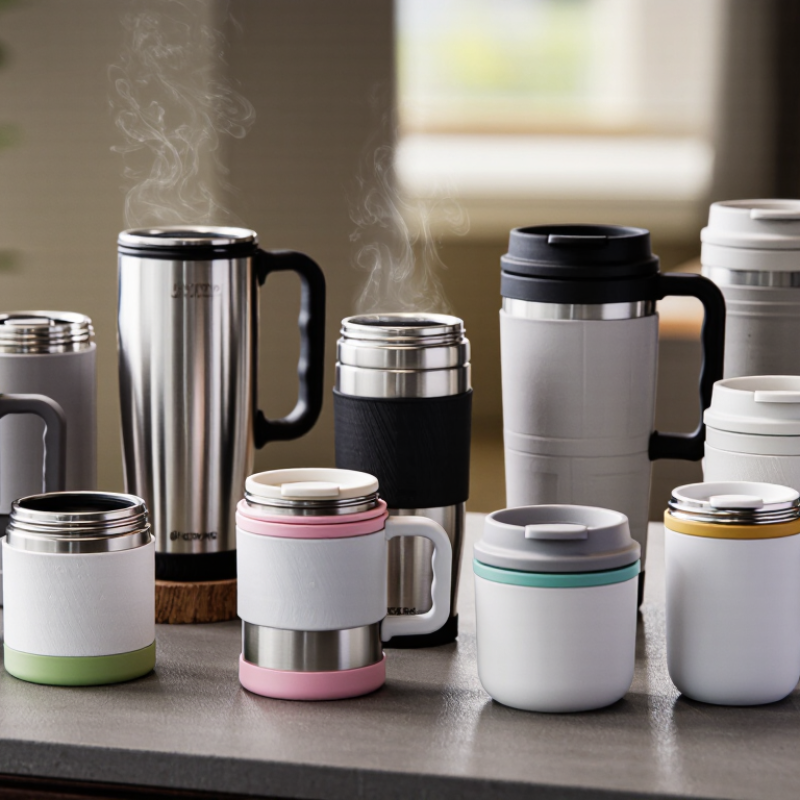
Global buyers will find several vacuum mug formats in 2026. Double-wall stainless-steel mugs remain the practical baseline for offices, vehicles, and outdoor work. They resist dents better than thin plastic and usually maintain temperature for six to twelve hours. Ceramic-lined models reduce metallic taste and suit coffee drinkers, although their inner coating may chip after repeated impacts. Handle mugs offer stronger control, while slim travel mugs fit common vehicle holders.
Market data supports this expanding category. Fortune Business Insights projects the global reusable water bottle market to rise from about USD 8.2 billion in 2023 to more than USD 12 billion by 2032. Grand View Research also reports steady growth through 2030, linked to reusable drinkware demand and daily commuting. These figures cover broader products, not vacuum mugs alone, so buyers should avoid treating them as exact mug sales.
Leak-resistant commuter mugs are gaining attention, especially those with locking lids and removable seals. Wide-mouth versions simplify cleaning and accept larger ice pieces, but they may spill more easily during sudden movement. Small mugs suit espresso and short commutes. Large mugs serve long desk hours, yet their weight becomes inconvenient when full. In my testing experience, lid design often matters more than insulation claims. Marketing numbers can look impressive. Real performance still depends on fill volume, opening frequency, and cleaning habits. One weakness remains: few reports separate ceramic-lined, stainless-steel, and temperature-display models clearly.
How Global Buyers Should Compare Vacuum Mug Types
2026 Top Vacuum Mug Types for Global Buyers
Global buyers should compare vacuum mug types by use, not appearance alone. Double-wall stainless steel mugs suit travel, offices, and outdoor work. They resist dents and usually provide reliable heat retention. Ceramic-lined models offer a cleaner taste for coffee and tea. However, their inner coating may chip after rough handling. Lightweight plastic versions can reduce shipping weight. They often need more careful temperature and durability checks.
Capacity affects freight, storage, and daily comfort. A 350-milliliter mug fits most car holders and small desks. Larger 500-milliliter models serve long commutes but add weight. Measure the base, lid height, and handle before placing a bulk order. A beautiful mug that does not fit common holders becomes a costly mistake.
Lid design deserves close inspection. Buyers should request leak tests, opening-cycle tests, and food-contact documents from suppliers. A sliding lid may support quick drinking, while a locking lid offers better protection in bags. Silicone seals can absorb odors if cleaning access is poor. Check whether users can replace them locally. Packaging also matters in humid shipping routes. Cartons need internal protection, but excessive packaging raises waste and cost. No type wins every market. I would still test samples with real drinks before approving a large order. Testing only with water can hide taste, sealing, and cleaning problems.
Choosing the Right Vacuum Mug for Different Markets and Uses
2026 Top Vacuum Mug Types for Global Buyers
Choosing the right vacuum mug depends on climate, transport, and drinking habits. Grand View Research estimated the global reusable water bottle market at USD 9.67 billion in 2023, with a projected 4.6% CAGR through 2030. This growth reflects demand for durable, reusable drinkware across many regions. However, one design cannot serve every market.
For hot coffee, double-wall stainless steel mugs with narrow lids suit offices and colder climates. Wide-mouth models work better for iced drinks, fruit pieces, or easy cleaning. In humid markets, a textured exterior improves grip when condensation forms. For commuters, buyers should check leak resistance, lid locking, and cup-holder compatibility. The U.S. Department of Energy explains that vacuum insulation reduces heat transfer through conduction and convection. Still, performance varies with lid design and seal quality. A thick wall alone is not enough.
Tips: Match capacity to use. Choose 300–400 ml for short commutes and 500–600 ml for long travel. Test the mug upside down before shipment. Check whether the seal survives repeated washing. ASTM International standards can support material and performance testing, but they do not replace practical trials. Market reports guide decisions, yet local feedback matters more than a perfect specification. I have seen attractive mugs fail because their lids were difficult to clean. That detail is easy to overlook.


.avif)


.png)