How to Use AI Translation for Accurate and Efficient Language Services?
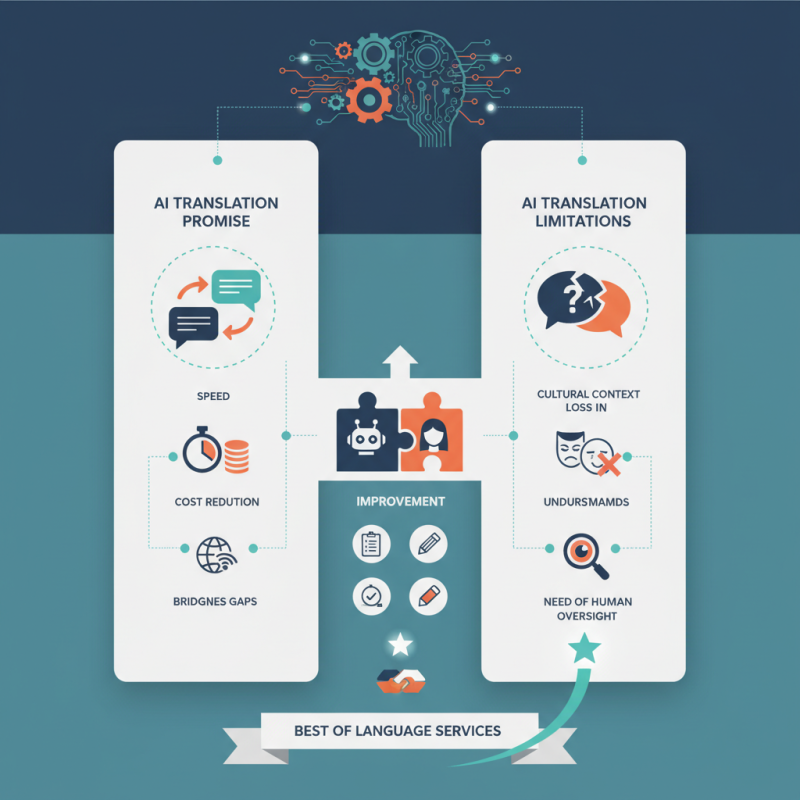
In the rapidly evolving world of language services, AI translation has become essential. Experts like Dr. Emily Carter, a leading figure in the AI translation industry, emphasize its role in enhancing communication. She once said, "AI translation bridges gaps, but it’s not infallible." This statement captures both the promise and limitations of AI translation technology.
Many organizations harness AI translation for efficient language services. It speeds up processes and reduces costs. However, the nuances of language can challenge these systems. Cultural context is often lost in translation, leading to misunderstandings. Users must be aware that while AI translation is a powerful tool, it still requires human oversight.
Embracing AI translation does not mean sacrificing quality. Companies can improve accuracy by combining AI with human expertise. Regular reviews and edits are vital. Mistakes can occur, so reflecting on these shortcomings is essential for improvement. By doing so, businesses can leverage the best of both worlds to offer better language services.
Understanding AI Translation: A Key to Modern Language Services
AI translation is revolutionizing language services. It offers speed and efficiency that traditional methods struggle to match. The technology can quickly process large volumes of text, making it ideal for businesses and individuals needing immediate assistance. However, nuances in context can sometimes be lost. This creates challenges in tone and cultural sensitivity, which are crucial in effective communication.
Understanding AI translation is essential for its integration into modern language services. For instance, while AI can translate phrases quickly, it often relies on patterns over deep comprehension. This may lead to translations that sound robotic or lack emotional depth. It’s important to review AI outputs carefully, especially in formal settings. Human oversight remains vital for accuracy.
As AI translations continue to evolve, the hope is that they will bridge language gaps more effectively. Yet, the limitations highlight a need for continuous reflection on its application. Users must remain aware that while AI is a powerful tool, it cannot replace the human touch in language services. After all, understanding does not stem from words alone, but from the emotions and intentions behind them.
How to Use AI Translation for Accurate and Efficient Language Services?
| Language Pair |
Accuracy (%) |
Speed (Minutes) |
Use Case |
| English - Spanish |
95 |
2 |
E-commerce Translation |
| Chinese - English |
92 |
3 |
Legal Documents |
| French - English |
90 |
4 |
Marketing Materials |
| German - English |
93 |
3 |
Technical Manuals |
| Japanese - English |
91 |
5 |
Subtitles for Videos |
The Role of Machine Learning in Enhancing Translation Accuracy
Machine learning has revolutionized translation services, making them more accurate and efficient. By analyzing vast amounts of bilingual text, machine learning algorithms learn patterns in languages. This allows for a smoother translation experience. These systems adapt over time, improving accuracy with each interaction. However, they still struggle with idiomatic expressions and cultural nuances, which can lead to awkward translations.
For example, a straightforward sentence like "kick the bucket" may be translated literally, losing its deeper meaning. Humans must review these translations, providing context that machines often miss. Collaboration between AI and human translators is essential for high-quality results. As technology advances, we can expect continued improvement, but complete reliance on machines is risky.
Moreover, different languages pose unique challenges. Some languages have complex grammar rules that AI struggles to grasp fully. Users should remain critical of automated translations. AI can assist with the heavy lifting, yet it cannot replace human intuition and creativity. The future of translation lies in a balanced approach, blending technology and human insight for the best outcomes.
Evaluating Efficiency: AI vs. Human Translation Metrics and Data
When evaluating the efficiency of AI translation versus human translation, metrics play a crucial role. AI translation systems can process large volumes of text almost instantly. They can handle technical jargon, making them ideal for industries like technology and travel. However, AI struggles with nuances and cultural context. This is where human translators excel.
Human translators understand idioms and sentiment. They capture the essence of a message, something AI often overlooks. In many cases, the translated text can sound robotic. An example is when AI fails to grasp sarcasm or humor, leading to confusion. Metrics should include accuracy and cultural relevance, not just speed.
AI can provide quick translations, but it lacks emotional intelligence. The perfect translation requires both speed and understanding. A balance between human and AI can leverage the strengths of both. While AI makes translation accessible, it is essential not to underestimate the human touch. A reflective approach can help identify where AI falls short.
Integrating AI Translation into Existing Language Services Frameworks
Integrating AI translation into existing language services frameworks can boost efficiency drastically. According to a recent study by the Globalization and Localization Association, 70% of companies that utilize AI translation report improved turnaround times. This technology allows for rapid processing of large volumes of text. It can significantly reduce operational costs as well.
However, the integration process isn’t flawless. Companies must ensure that AI tools fit seamlessly with human translators. This blend of technology and human skills is critical. A report by the Localization Industry Standards Association points out that 83% of linguists believe AI should complement their work, not replace it. AI might misinterpret cultural nuances, leading to potential misunderstandings.
Not every language pair is handled equally well. For example, languages with complex grammatical structures often present challenges. It’s essential to systematically evaluate translation accuracy. Regular feedback loops can help fine-tune AI systems. Moreover, organizations should train employees on using these tools effectively. Continuous learning is essential in this fast-paced environment.
Usage of AI Translation in Language Services
This bar chart illustrates the increasing usage of AI translation in language services from 2019 to 2023. As technology improves, the adoption of AI translation tools in the industry has surged, highlighting the trend towards more efficient and accurate language services.
Future Trends: AI Translation Innovations and Their Impact on the Industry
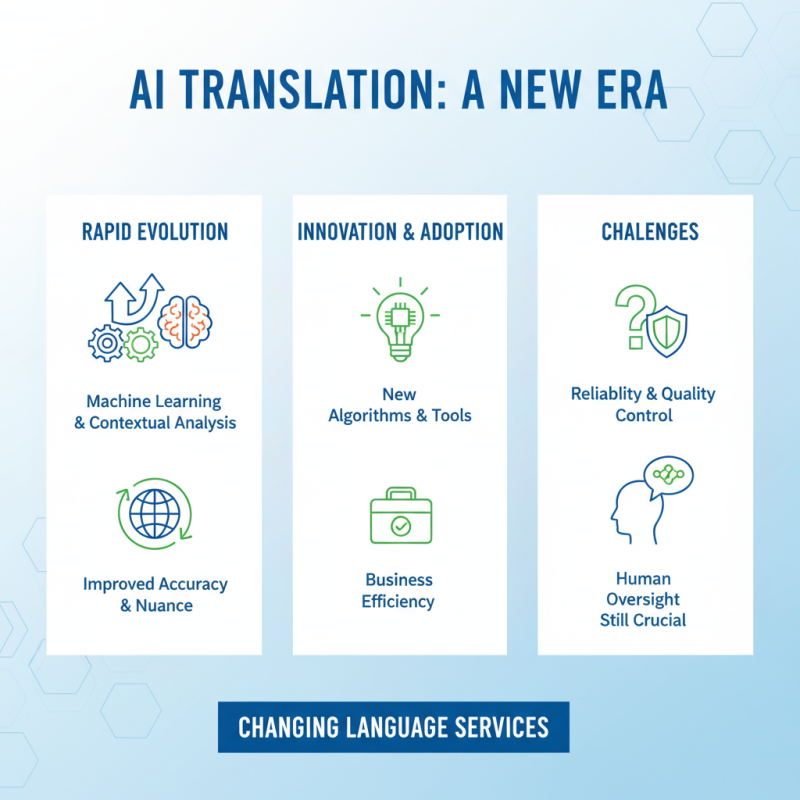
AI translation is evolving rapidly. Innovations are emerging, changing how language services operate. Machine learning algorithms are improving. They analyze context better now. This leads to more accurate translations. Businesses are adopting these tools for efficiency. However, reliance on AI isn’t without challenges.
One major concern is the nuances of language. AI often struggles with idioms and cultural references. It may miss emotional tone, which humans understand. Users need to be cautious. A simple phrase might lose its meaning in translation. Even with advancements, not every translation is perfect.
The industry's future looks promising, yet imperfections remain. AI can assist translators, but it must not replace them. Human insight is still crucial. For sensitive content, a human touch is needed. This poses a question: how can we balance efficiency with personal understanding? The journey of integrating AI into translation services continues to spark debates.




.avif)


.png)