Top 10 Best AI Translator Free Tools You Should Try?
In today's globalized world, clear communication across languages is essential. The rise of AI translator free tools has revolutionized language translation, making it accessible to everyone. According to a report by Common Sense Advisory, about 75% of internet users prefer content in their native language. This highlights the growing demand for effective translation tools.
AI translator free tools offer a practical solution to this challenge. These tools leverage advanced algorithms and machine learning to provide quick and accurate translations. Research indicates that machine translation quality has improved significantly over the years, with many AI translators now capable of producing results comparable to human translators for various languages. This is particularly beneficial for businesses aiming to reach broader audiences.
Despite advancements, AI translators are not flawless. They can struggle with context, idioms, and cultural nuances. Users sometimes encounter issues with accuracy and coherence. It's essential to approach AI translations critically, understanding both their capabilities and limitations. Exploring the top 10 best AI translator free tools can help individuals and businesses make informed choices in their communication needs.

Understanding AI Translators: An Overview of Their Functionality
AI translators are transforming the way we communicate across languages. They leverage advanced algorithms and machine learning to produce quick and accurate translations. A recent report by the International Data Corporation indicates that the machine translation market will surpass $1 billion by 2025, reflecting growing demand.
Most AI translators function by using neural networks to analyze and render text. They have the ability to learn from vast amounts of data, allowing them to improve over time. This offers significant advantages in terms of accuracy. However, the quality of translations can vary. Some nuances and cultural references may not be captured perfectly.
Tips: Always double-check translations for critical documents. Relying solely on AI may lead to misunderstandings. Try different tools to see which ones suit your needs best.
Bear in mind that context is essential in translation. AI might miss subtleties in tone or intention. Users should approach translations with a critical eye. Feedback is crucial for improvement, as it helps refine algorithms for future accuracy.
Criteria for Evaluating Free AI Translation Tools
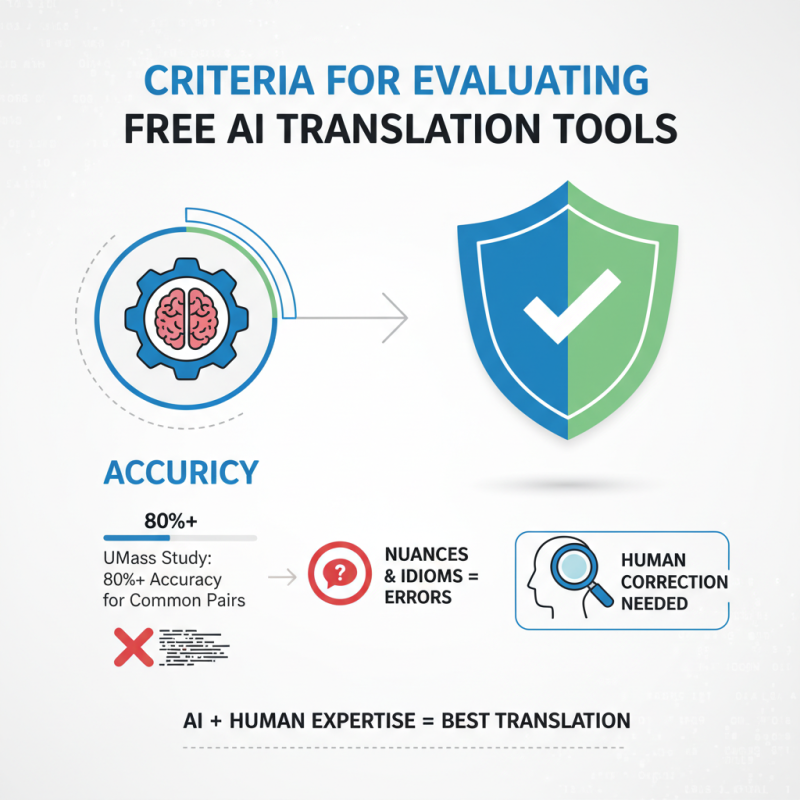
When evaluating free AI translation tools, several key criteria emerge. First, accuracy is crucial. According to a study by the University of Massachusetts, advanced AI translation technologies can achieve over 80% accuracy for common language pairs. However, nuances in language often lead to errors, especially with idiomatic expressions. This highlights a gap where human correction remains necessary.
Another important criterion is user experience. Complex interfaces can deter users. Research from Nielsen Norman Group indicates that ease of use directly affects user satisfaction. Tools must be intuitive, ensuring users can navigate without frustration.
Additionally, language support is vital. With over 7,000 languages globally, comprehensive tools should cover a wide array. However, many platforms focus on major languages, neglecting less commonly spoken ones. This can limit accessibility for users needing translation in regional dialects. Evaluating these factors helps users select the right AI translation tools. A tool might excel in one area but falter in another. Balancing these criteria is essential for effective communication.
Top 10 Free AI Translator Tools You Can Use Today
In today's globalized world, effective communication is crucial. AI translator tools have revolutionized language translation. These tools utilize advanced algorithms to provide quick and accurate translations. A recent report from Statista indicates that the global market for machine translation is expected to reach nearly $1.5 billion by 2027. This growth underscores the increasing need for reliable translation solutions.
Several free AI translator tools allow users to bridge language gaps quickly. For instance, many employ neural machine translation, enhancing context understanding. However, limitations still exist. In a study by the Journal of Artificial Intelligence, 30% of translations contained inaccuracies, particularly with idiomatic expressions. This emphasizes the need for human oversight, especially in nuanced texts. While AI tools are effective, they may not always capture cultural subtleties.
Accessibility is another key factor. With over 4.9 billion internet users worldwide, offering free AI translator tools can empower individuals from diverse backgrounds. These tools democratize access to information. Nevertheless, users should be cautious. Some translations may lack precision due to incomplete contextual data. This inherent flaw serves as a reminder that while technology excels, human expertise remains irreplaceable in certain situations.
Top 10 Free AI Translator Tools You Can Use Today
| Rank |
Tool Name |
Supported Languages |
Features |
Website |
| 1 |
Free AI Translator A |
100+ Languages |
Text, Voice, Image Translation |
www.freeaitranslatorA.com |
| 2 |
Free AI Translator B |
50+ Languages |
Text, Speech Translation |
www.freeaitranslatorB.com |
| 3 |
Free AI Translator C |
75+ Languages |
Text, Image Translation |
www.freeaitranslatorC.com |
| 4 |
Free AI Translator D |
30+ Languages |
Text and Document Translation |
www.freeaitranslatorD.com |
| 5 |
Free AI Translator E |
10+ Languages |
Text Translation |
www.freeaitranslatorE.com |
| 6 |
Free AI Translator F |
20+ Languages |
Voice and Text Translation |
www.freeaitranslatorF.com |
| 7 |
Free AI Translator G |
40+ Languages |
Text, Document, and Image |
www.freeaitranslatorG.com |
| 8 |
Free AI Translator H |
25+ Languages |
Text Translation |
www.freeaitranslatorH.com |
| 9 |
Free AI Translator I |
15+ Languages |
Text and Image Translation |
www.freeaitranslatorI.com |
| 10 |
Free AI Translator J |
5+ Languages |
Basic Text Translation |
www.freeaitranslatorJ.com |
Comparative Analysis of Features in Free AI Translators
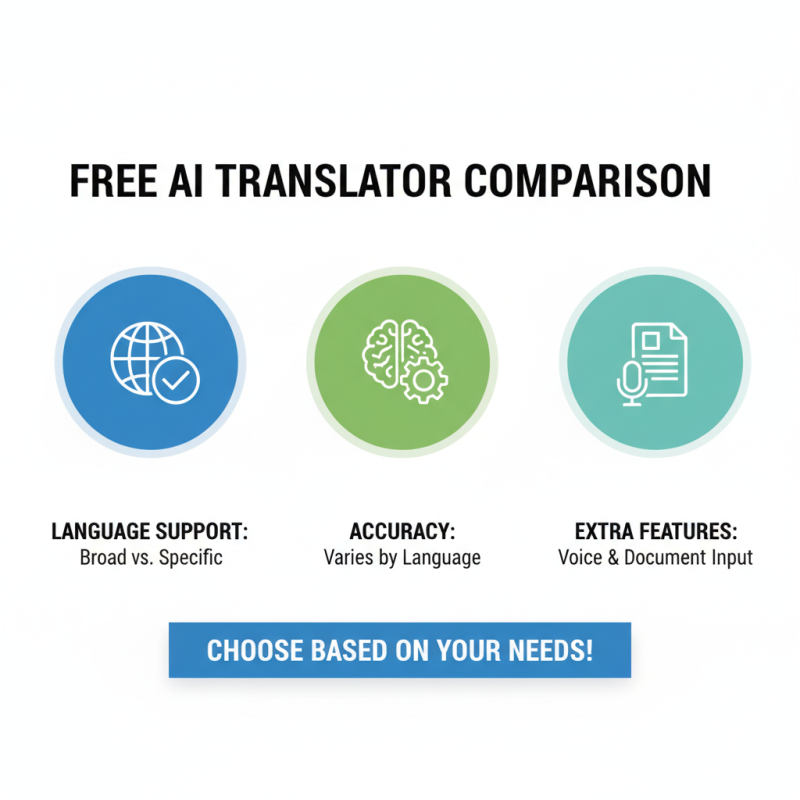
When exploring free AI translators, it’s crucial to analyze their features. Many tools offer basic translations, but their accuracy can vary widely. Some translators excel in specific languages, while others provide broader language support. Features like voice input and document translation are essential for user convenience.
User interface plays a significant role. A clean, intuitive design enhances user experience. Some tools may have complicated settings, which can discourage use. Additionally, the speed of translation can impact productivity. Slow response times might frustrate users seeking efficiency.
Machine learning advancements influence translations. Some tools improve over time, learning from user interactions. However, not all free options apply these updates consistently. Paid alternatives might offer superior performance and features. Analyzing feedback from user reviews helps gauge reliability, as experiences vary. The best choice depends on individual needs and preferences.
Future Trends in AI Translation Technology and Tools
The future of AI translation technology is rapidly evolving. Recent reports indicate that the market for AI translation is projected to reach $15.5 billion by 2027. This growth highlights increasing reliance on AI-powered tools. Developers are focusing on improving accuracy and contextual understanding. Understanding cultural nuances is still a challenge. Language translation is not just about words; it involves meaning and context.
Innovations are emerging, especially in neural machine translation. This technology mimics human translation more closely than before. Yet, even advanced AI systems sometimes struggle with idiomatic expressions. Data from industry studies show that user satisfaction declines when translations lack cultural sensitivity. The ability of AI to learn from feedback is vital. However, many tools still need refinement to deliver contextually accurate translations.
As the technology advances, collaboration between human translators and AI is essential. AI can handle large volumes quickly. However, experts argue that human expertise is needed for precise nuances. Reports indicate that 67% of users still prefer human oversight in sensitive translations. This balance can foster greater trust in AI tools. The future might be bright, but it requires addressing these complexities to achieve reliable translation outcomes.
Top 10 Best AI Translator Free Tools Usage Statistics








.avif)


.png)